
BLACKLAND PRAIRIE CUISINE – A PHILOSOPHY, OF SORTS
First, A Word
Farm to table. The phrase is ubiquitous. The meaning is implied, but the bell has begun to ring hollow. As I look back at the eight since The Heritage Table opened – as a farm-to-table restaurant – that felt like enough; it was a quick few words meant to imply our sourcing and, perhaps to a lesser extent, our style. But we have changed, and perhaps the meaning of Farm To Table has changed as well. But as we continued developing relationships with our partner farmers and ranchers continued, year after year, to plan our menus and our preserves around what they were growing, it turned our menu into something uniquely … here. Not cultural or according to arbitrary borders, but defined by ecology. People would ask if we were farm to table, and I would answer, “well, kind of.” I didn’t know what to tell people the style of food we served, because I didn’t know what to call it.
So I wrote this. Blackland Prairie Cuisine – A Philosophy, of a Sort, is my attempt to describe our efforts to define our regional cuisine, created by those who are producing the food here and only defined by techniques adapted to those ingredients, in that order.
It’s not a manifesto and it’s not a fixed set of rules. It’s an invitation to let our farmers and ranches, our seasons, and our community – culinary professionals, hobbyists and weeknight dinner warriors – define a cuisine that couldn’t exist anywhere else. To move beyond derivation and toward an independent palate of flavor that belongs wholly and only to the Blackland Prairie and its nearby ecological neighbors that comprise our culinary ecosystem.
Whether you’re in the kitchen, at the table, or simply curious about how an ecological region finds a voice (I’m curious about that part, too!), it is my sincere hope that you’ll read it as both an ever-evolving philosophy and a vision to be pursued.
— Rich Vana
Chef & Owner, The Heritage Table
Actual Introduction
Regional cuisines are living records of human adaptation. They are shaped not by chefs with manifestos, but by generations of people answering the same four questions: What can I eat nearby? How do I make it taste good? How do I use all of it? How can I save it for later? Over centuries, these answers have calcified into what we now recognize as culturally and/or geographically established cuisines; be it French, Italian, Vietnamese, or Indian cuisine, among hundreds of others – each a distinct conversation between geography, necessity, and creativity.
In many parts of America, and in Texas specifically, the story is different. Here, what we consider “regional” cuisine to be is rarely the product of slow, place-bound creative and cultural evolution. Those peoples who had established culinary traditions that evolved over centuries and millennia – they were driven out with a harsh, prejudiced tide of cultures unbothered by the cultural erasure of those that lived on the land before them. And those who led that tide brought instead a hodgepodge of their own influences adapted to local conditions – veal schnitzel made with beef becomes chicken-fried steak, mole morphs into chili, a line of barbacoa’s family tree evolves into barbecue. These are delicious results of mimicry, but mimicry nonetheless.
So it is that Texas has an amalgamated cultural cuisine. A state that would overlay a large swath of the European continent, a state with 10 separate ecological regions, has a culinary identity that is so easily enveloped by the ideas developed outside of necessity, and rather by cultural adaptation and approximation based on what could be found here. Thus The Blackland Prairie has the potential to become something different. But to define a cuisine here, we must first accept that it is barely defined at all. We must strip away attempts at historic and cultural reconstruction, quiet the nostalgia, and return to those four fundamental questions, letting the farms, ranches, and wild spaces dictate the answers. Doing so doesn’t just give us a cuisine with identity — it strengthens the local food chain, supports sustainable and ethical agriculture, and creates a closed loop between land, grower, and plate. It is a chance to craft a cuisine interwoven to its place and presence; its own dialect of a language the world has spoken since time immemorial.
Development of Regional Cuisine
Before a cuisine can be described or roughly defined, much less codified, it must first be grown, nurtured and developed. Not in a glamorous fashion, but fashioned as it sustained the lives of those who drove its evolution. And in every food culture that predates the printing press – and most that postdate it – the same four questions guided how people fed themselves:
- What’s nearby that I can eat now?
Every cuisine begins with geography. The fish in Japanese narezushi, the grains in Indian chapati, the bamboo in Thai Bamboo Shoot Curry— all are dictated by climate, soil, and proximity. Early cooks weren’t selecting ingredients from a global market; they were responding to what their fields, forests, rivers, and coasts offered at that moment. - How do I use all of it?
Waste was simply impractical. From Provençal fish stews to Chinese bone broths, frugality shaped flavor. This principle built not just efficiency, but identity — it explains why certain cuts, offal, or otherwise-known “peasant dishes” often became cultural icons as generations relied on innovation and practicality to cultivate and hone a once-humble dish. - How can I save it for later?
Preservation was less about ethical ambition than it was about survival. Salting, drying, fermenting, smoking – these were not stylistic choices. They were strategies against scarcity. Entire flavor profiles, from Parma ham to kimchi, owe their existence to the human need to stretch abundance into leaner seasons. - How do I make it taste good?
Palates develop within the boundaries of what’s available. Herbs, spices, cooking fats, and cooking methods emerge as flavor solutions to geographic realities. Italian basil meets tomatoes in summer; French butter enriches root vegetables in winter. Taste is a culture’s response to nature’s offerings.
Together, these tenets carved the unseen pillars of every old-world cuisine. They evolved over centuries, certainly adapting incrementally to trade, migration, and agricultural change, but always in concert with the land. The result was food that tasted not only of place, but of time – an ever-evolving cuisine driven by the accumulated memory of generations eating from the same soil, even while selectively breeding and incorporating new staple ingredients as trade and development allowed.
Codification
The codification – the formal recording of recipes, techniques, and ingredient lists – has been the greatest gift and the greatest curse to these magnificent cuisines that have had centuries and millennia to develop. It has made them accessible, translatable, and teachable beyond their borders. Without codification, a Parisian sauce technique might never reach New York, nor a Vietnamese pho broth find its way to Melbourne. But once enshrined, these rules often shift from descriptive to prescriptive, transforming living traditions into rigid formulas where deviation becomes perceived as derivative at best, and often culinary heresy at worst. What began as an organic response to land and circumstance becomes a venerated, but stagnant, ode to past culinary innovation.
This was a – perhaps the – turning point. For the vast majority of human history, cuisine was taught and learned mouth-to-ear, hand-to-hand. You learned to cook by standing beside someone who had done it longer, by stirring when they told you to stir and tasting when they told you to taste. There were no recipe books, only recipes lived. Codification – the recording of these oral traditions in a way that could be perceived as canonical – changed that forever.
The great gift of codification was its broad reach – once a cuisine was documented, it could travel further than its ingredients. Codification democratized cuisine, making it teachable in culinary schools, exportable through media, and reproducible in home kitchens far from its origin.
But codification also planted the seeds of constraint. What began as a descriptive act – that is, capturing what people were cooking – too often morphed into a prescriptive act, dictating how people should cook. Over time, those written recipes became rules, and the idea of “authenticity” hardened into dogma.
Therein lies the irony: the cuisines we now guard so fiercely almost universally arose from solving the same basic problems. Across continents and centuries, cultures with no contact arrived at similar answers: moles and curries; tacos and gyros; chicken noodle soup and ramen; bouillabaisse and creamy Scandinavian fish soup. Different voices, same instincts. Techniques were – and still are – human tools, shaped by local conditions, not the property of any one place. Codification, for all its value, can lead us to the conclusion that culinary evolution – not to be mistaken with artistic flourishes – has reached its pinnacle.
Adaptation vs. Organic Evolution – The American Case
Old-world cuisines were a slow ferment, so to speak. Centuries of eating from the same soil and seasons allowed them to develop not only distinct flavors but ingrained cultural reflexes — what spices to reach for in winter, which preservation methods to trust in summer, what combinations simply “made sense” because they had been made for generations. In the United States, and in Texas in particular, cuisine has rarely had that luxury of time. Instead, American regional food has been built on a foundation of rapid adaptation — a collision of immigrant cultures, indigenous ingredients, and the realities of a new landscape.
Consider chicken-fried steak — essentially schnitzel translated into beef, dredged in flour, fried crisp, and topped with cream gravy. Or chili, a dish with roots in Mexican mole, stripped down to its core aromatics and heat. Or barbecue, which draws its lineage from Caribbean and Mexican barbacoa, adjusted to suit the hardwoods, livestock, and palates of the American South and West. These dishes are beloved and delicious, but they are also products of imitation — an existing idea adapted to what was at hand, rather than a wholly original expression of place.
The four fundamental tenets still apply in these examples — local beef in place of veal or pork, chilies where they can be grown, smoke as both a flavor and a preservation tool. But what is missing is the deep time that cements those adaptations into a reflexive cultural identity. French bouillabaisse tastes the way it does because generations of cooks, all on the same coast, refined it over hundreds of years. Texas barbecue, in contrast, leapt to popularity in decades near the end of the 19th century and the beginning of the 20th.
This is not a flaw of American cuisine. It is, in fact, a defining trait: speed, flexibility, and openness to influence. But it also explains why, when we try to discuss “Texas cuisine” or a “Blackland Prairie cuisine,” we often reach for a greatest-hits menu of borrowed dishes rather than a coherent language of our own. The question, then, is whether we can move from mimicry toward identity – not by rejecting our borrowed flavors, but by grounding them in the land we stand on now.
Blackland Prairie Cuisine: What It Mostly Isn’t
To define Blackland Prairie cuisine, we first have to admit an uncomfortable truth: it barely exists. There is no centuries-old matrix of flavor and technique here, no inherited reflexes telling us exactly how to season the greens or cure the pork. What we call “regional” in this stretch of Texas is often a collage of borrowed dishes — chicken-fried steak, mashed potatoes, chili, barbecue — bound together more by nostalgia than by terroir. These foods are delicious, and they belong to our story, but they are not the whole story.
If we want to give Blackland Prairie cuisine a true identity, we have to set aside, at least for now, the weight of cultural mimicry. We have to look through the lens of those four fundamental questions and respond to what we find.
And we must accept something deeper — that humanity, as vastly different as we are, tends to think the same way in the kitchen. If you have a rich broth and noodles, you might call it chicken noodle soup in Texas or ramen in Tokyo. A spiced, saucy stew might be mole in Mexico or curry in India. These aren’t copies; they’re parallel answers to the same question. If I make a chicken noodle soup with a deep, emulsified broth, have I made a play on ramen, or have I just made chicken noodle soup? Perhaps both.
This is why borrowing technique is not a betrayal of authenticity. Just as Eastern Europe and Korea both fermented cabbage, we can draw from the world’s toolbox — smoking, fermenting, curing — and apply those methods to what grows here. The result will not, and should not, taste like Mexico, Japan, or France. It will taste like the Blackland Prairie and our surrounding areas, because the seasons and the soil are uniquely ours.
And What It Is – Or, at Least, Where it Begins
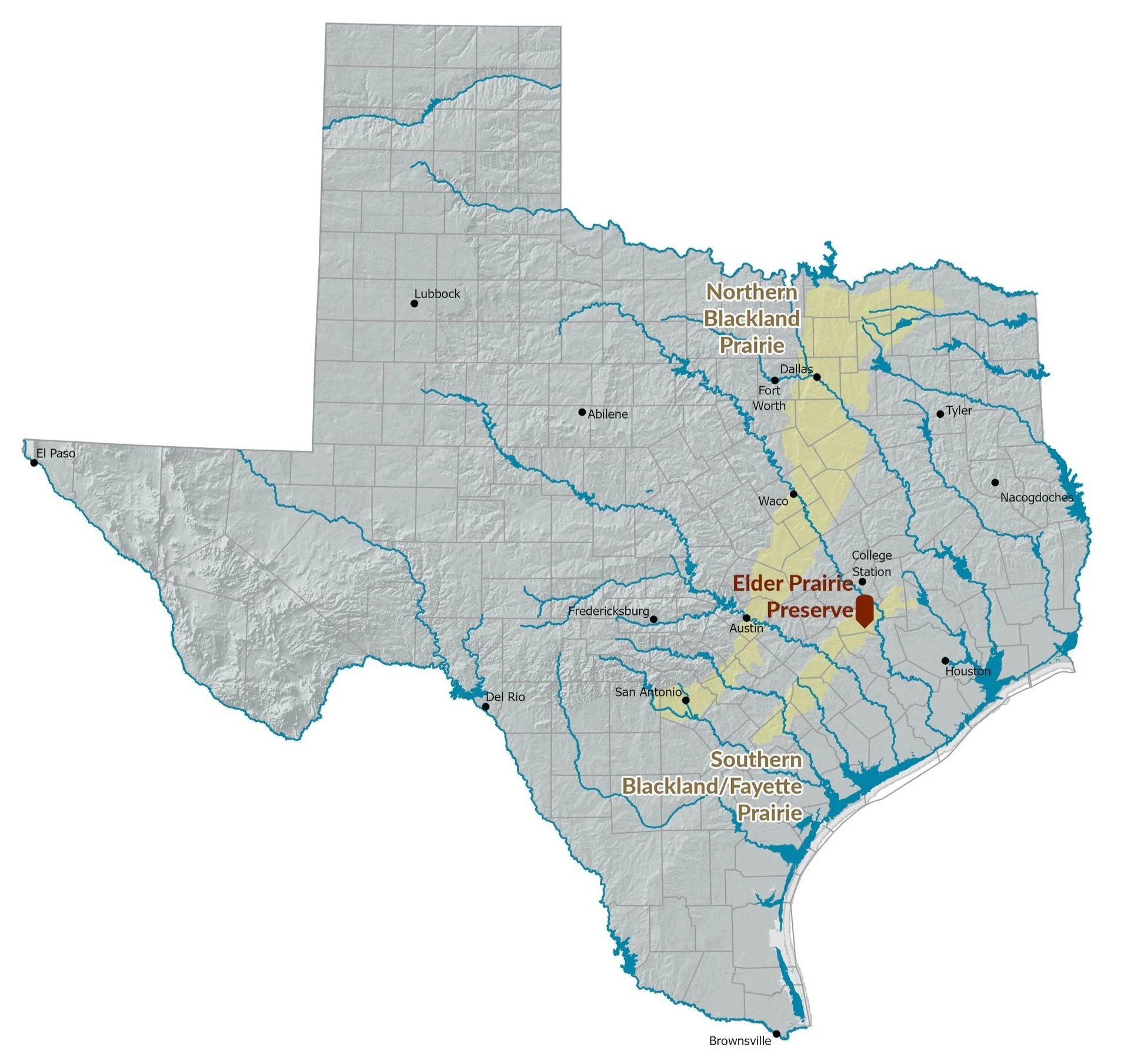
To know our framework, our structure, we look to the skies. The Blackland Prairie lies in a Humid Subtropical Climate – that is to say, hot summers and mild winters. It is a climate that supports just about any fruit or vegetable you’ll find at the grocery store, save citrus and some brassicas. But it doesn’t always yield such a harvest with great willingness. The clay soil, the often-oppressive summertime heat, unpredictable (sometimes seemingly absent) precipitation are among just a few of the factors that can determine the difference between a year of bounty and a season of futility.
It is with hope for the former that in Spring farms across the Blackland Prairie plant their seeds and seedlings – heat tolerant nightshades and legumes, thermophilic okra that thrives in the August sun. Sweet potatoes and winter squash can all last through the new year if luck holds, and farmers can entice leafy greens out of the soil throughout the year. And strawberries, raspberries, blueberries, apricots – they’re all on the menu before mid-May and off of it by June. Peaches in a good year may last for a couple of months, and by the end of summer the sweet harvest has ended. But with a bit of planning and preservation, a fair Spring can allow the soil to produce a year’s worth of sweet fruits in many different forms.
In fact, it is the preservation aspect that bridges the growing seasons together. Through lean years and bountiful ones, the pickles and bacon, the cured meats and jams prepared as precaution intermingle with the fresh fruits off the plant or the grilled meats from a farmer’s recent cull. It is a cuisine not defined season by season, but by how the seasons are stored in a bottle and interwoven with the harvest of others. Beers and wine, cheeses, pickles, cured meats and jellies and jams and vinegars – what is any cuisine without its preserves? The more we are driven to purposefully take what we are given and save it for later, the more we are able to curate the inimitable flavors of our own landscape. And then, after controlling what we can, we relish in the abundant years in a climate that, when agreeable, can yield nearly any fruit or vegetable that an optimistic farmer or gardener may endeavor to grow.
A Vision for the Cuisine
Blackland Prairie cuisine has the rare advantage to define itself with intention. We are not locked into centuries of codified rules, nor are we burdened with protecting a chiseled definition of “authenticity.” That freedom is not an absence of identity – it’s an open field.
The guiding principle is simple: let the four tenets drive every decision. These questions will naturally draw us toward the flavors and techniques that belong here, and nowhere else.
From this framework, a vision emerges:
- Seasonal immediacy — Menus that shift with the field, the orchard, and the pasture, reflecting the week’s harvest rather than a fixed calendar of dishes.
- Whole-use cooking — Treating every cut, trim, and leaf as an ingredient, from rendering fat into cooking oil to fermenting stems into condiments.
- Preservation as heritage — Smoking, curing, drying, and fermenting not as borrowed trends, but as tools for carrying abundance into the lean months.
- Global techniques, local expression — Using methods from any culture when they fit the ingredient: Czech smokehouses for Texas pork, nixtamalization for local corn, Japanese-style pickling for Prairie vegetables. The authenticity is in the ingredient and the place, not in the passport of the method.
The flavors in Blackland Prairie cuisine are defined its practices. The culture that follows this philosophy is, by necessity, one of sustainability and ecological awareness. By building menus around what’s produced locally and ethically, we create a self-sustaining food economy:
- Sustainable farms and ranches gain stable, loyal markets.
- Shortened supply chains reduce environmental impact and insulate us from global disruptions.
- Ethical animal husbandry becomes the norm, supported by chefs and diners who value quality born of care and consciousness.
North Texas doesn’t need truffles or caviar to stand among the world’s great cuisines. Our wealth lies in marbled steaks from cattle raised a few miles away, heritage pork that’s had room to roam, ducks with deep, complex fat, and vegetables pulled from rich soil hours before they hit the plate. It lies in beans bred for our climate, sweet corn that needs no embellishment, and melons that perfume the kitchen when cut. It lies in the ability to tell our guests that what they are eating could not have been made exactly the same way anywhere else, by anyone else. Not because of who we are, but because of where we are.
If we commit to this vision, then a generation from now, when someone asks “What is Blackland Prairie cuisine?” the answer will not be a list of borrowed dishes. It will be a living tradition, rooted in this land – and perhaps recognized beyond it! – not because we copied the past, but because we are aware of our present.
Regional cuisine is never born fully formed, nor ought it ever be fully defined. It begins as a relationship between people and the land, shaped by what can be grown, hunted, or gathered; refined over generations through trial, error, and necessity. Codification has made it possible for a sausage from Bratislava or a noodle from Hanoi to cross oceans and find new audiences. But it has also made it possible for those same traditions to harden into immovable rules, stifling the very adaptation that gave them shape.
In Texas, our regional foods have been built quickly, often by adapting the dishes of other cultures to our own landscapes. This adaptability is a strength, but it has left us with a patchwork identity – a table full of delicious plates that tell more of where we came from than where we are, or wish to be.
The Blackland Prairie offers a rare opportunity: to define a cuisine not by what we inherit, but by what we choose to create. We allow our fields, ranches, and wild spaces to shape our plates.
Doing so will not only give us a cuisine that tastes unmistakably of this place, but also one that strengthens our local food systems, supports ethical and sustainable agriculture, and shortens the distance from soil to table. We will have built a loop where land, grower, and chef depend on each other, ensuring that the identity we forge is one we can sustain.
Fifty years from now, Blackland Prairie cuisine could be referenced with the same certainty we use for Tuscany or Provence – not because we carefully guarded a fixed canon, but because we let our land and its farmers, our seasons, and our ingenuity define us. The opportunity is here, the ingredients are here, and the appetite is here. All that remains is to put the vision on the table.